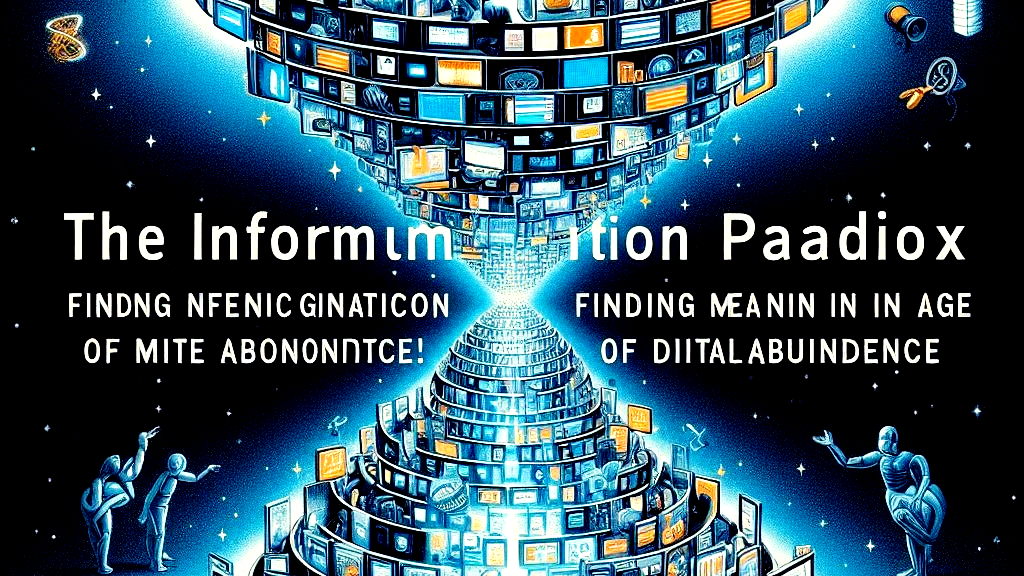
Introduction To The Information Paradox

In our hyper-connected era, we find ourselves amid what might be called the great information paradox: despite unprecedented access to knowledge, many of us experience a profound sense of boredom and disconnection. This contradiction merits closer examination, as it reveals fundamental truths about technology’s relationship to human psychology and the quest for meaning in modern life.
The Infinity Machines and Their Promise
Consider the ubiquitous scene on any morning commute: rows of passengers transfixed by their smartphones—what we might aptly term “infinity machines.” These pocket-sized devices offer a window onto more content than any human could consume in multiple lifetimes: the collected knowledge of civilization, endless entertainment options, and infinite social interactions. The technological achievement is staggering by any historical standard. Just twenty years ago, such capabilities would have seemed like science fiction.
The promise embedded in these technologies echoes the bold declaration made by Stewart Brand in 1984: “Information wants to be free.” This assertion, which became a rallying cry for internet idealists, carried with it an implicit assumption that liberating information would liberate humanity. The belief system underpinning our digital age suggests that more information inevitably leads to more enlightenment, satisfaction, and meaning.
The lineage of this technological optimism can be traced directly to the Californian counterculture of the 1960s. The same visionaries who once sought transcendence through communes and consciousness-expanding substances later channeled their utopian energies into digital platforms. Stewart Brand himself exemplifies this transition—from the psychedelic explorations chronicled in Tom Wolfe’s “The Electric Kool-Aid Acid Test” to founding the Whole Earth Catalog (described by Steve Jobs as “Google in paperback form”) and later the WELL (Whole Earth ‘Lectronic Link), one of the internet’s first virtual communities.
This historical connection is not merely incidental. It shaped the fundamental narratives through which we understand digital technology. The counterculture’s “turn on, tune in, drop out” was reborn in digital form, with information replacing LSD as the transformative substance. The internet needed a compelling story to capture public imagination, and these digital pioneers provided one steeped in liberation mythology.
The Boredom Epidemic: A Modern Paradox
Yet despite this cornucopia of content, boredom persists—and according to some metrics, is increasing. Consider the troubling case of the 23-year-old British woman who, when asked why she had sent rape threats to a feminist campaigner online, cited being “off her face” and “bored.” Academic research in publications such as the Journal of Politeness Research and the Journal of Language Aggression and Conflict frequently identifies boredom as a primary motivation for internet trolling behavior.
This persistence of boredom amid information abundance represents a profound market failure in our attention economy. The infinity machines promised endless stimulation, yet delivered something quite different. Why?
The answer lies in understanding the crucial distinction between information and meaning. Information, in its raw form, does not nourish the human spirit. A collection of facts, no matter how vast, remains inert without the alchemical transformation that converts data into insight. As one analyst aptly observed, there is a significant difference between “memorizing the bus timetable for a city you will never visit, and using that timetable to explore a city in which you have just arrived.”
The Information-Meaning Gap: A Quantitative Analysis
To appreciate the scale of this information-meaning gap, consider the following metrics:
- Average smartphone users check their devices approximately 96 times daily (or once every 10 minutes during waking hours), according to research from Asurion.
- The global volume of data created, captured, copied, and consumed worldwide reached 59 zettabytes in 2020 and is projected to exceed 175 zettabytes by 2025 (IDC Data Age 2025 study).
- Despite this abundance, researchers at Harvard Business School found that knowledge workers report feeling more fragmented and less satisfied with their ability to make sense of information.
These statistics highlight a fundamental inefficiency in our information processing systems—both technological and cognitive. We have optimized for data transmission but neglected the equally crucial processes of synthesis, integration, and meaning-making.
Historical Context: Boredom as an Industrial Byproduct
To understand our current predicament, we must recognize that boredom itself is not a timeless aspect of the human condition but rather a historical development coinciding with industrialization. The term “boredom” emerged around the same era as the spinning jenny, reflecting the psychic conditions created by the division of labor, the separation of production from consumption, and the rationalization of work.
The industrial revolution introduced widespread endemic boredom through repetitive tasks and the alienation of workers from the fruits of their labor. Our digital revolution promised liberation from these constraints through unlimited information access. Yet in practice, it often intensifies rather than alleviates this condition.
Case Study: The Content Consumption Treadmill
Consider the modern streaming entertainment landscape. Netflix, Disney+, and other platforms offer more high-quality content than previous generations could have imagined. The average American household now has access to 5.4 streaming services, representing thousands of hours of premium content.
Yet paradoxically, 44% of subscribers report feeling overwhelmed by too many choices, leading to the well-documented phenomenon of “choice paralysis.” Viewers spend an average of 7.4 minutes browsing before selecting content (or abandoning the search entirely). This behavioral pattern reveals the gap between information availability and meaningful engagement.
Similarly, social media platforms have perfected algorithms that deliver endless streams of content perfectly calibrated to trigger dopamine responses. Yet research from the Journal of Social and Clinical Psychology found that limiting social media use to 30 minutes per day led to significant reductions in loneliness and depression, suggesting that our current consumption patterns work against psychological well-being.
The Conversion Process: From Information to Meaning
What then is the process by which information becomes meaningful? It requires several key elements frequently absent in our current digital consumption patterns:
- Connection: Information gains meaning when it connects to our existing knowledge, experiences, or goals. Isolated facts remain inert.
- Context: Understanding the broader systems and histories in which information exists transforms raw data into insight.
- Contemplation: The human mind requires space for reflection—allowing new information to settle and integrate with existing mental models.
- Creation: Meaning often emerges through active engagement rather than passive consumption. We understand by doing, making, and applying knowledge.
- Community: Shared interpretation and collective sense-making amplify individual understanding.
Modern information technologies excel at delivery but often undermine these essential meaning-making processes. The constant stream of notifications, updates, and content fragments our attention, leaving little space for the deep engagement required for meaningful understanding.
Engineering Solutions: Designing for Meaning
This analysis suggests that we need to fundamentally rethink how we design information systems. Current metrics of engagement, time-on-site, and click-through rates optimize for attention capture rather than meaningful engagement. What might information technologies optimized for meaning look like?
Several promising approaches have emerged:
- Slow Tech Movement: Companies like Siempo are designing smartphones and interfaces that minimize distraction and encourage intentional use.
- Synthesis Tools: Applications such as Roam Research and Obsidian help users make connections between information fragments, supporting the creation of knowledge networks.
- Attention Protection Systems: From Freedom to Focus@Will, a growing ecosystem of tools helps users create the conditions for deep engagement.
- Regenerative Reading Platforms: Services like Readwise and Instapaper allow users to revisit and integrate content over time, rather than consuming and forgetting.
These approaches recognize that the value of information technology lies not in raw data delivery but in supporting human meaning-making processes.
The Deliberate Information Diet
Just as our physical health requires thoughtful nutrition rather than unlimited calories, our cognitive well-being demands a deliberate information diet. This means:
- Curating Input: Being selective about information sources based on quality, relevance, and integrity.
- Creating Space: Deliberately unplugging to allow for reflection and integration.
- Contextualizing Content: Seeking depth rather than breadth, understanding systems rather than isolated facts.
- Cultivating Creation: Balancing consumption with production—writing, making, applying, and sharing.
- Community Engagement: Participating in collective sense-making through thoughtful discussion and collaboration.
Organizations that help employees implement such practices are seeing remarkable results. Microsoft’s research division found that employees who engaged in structured reflection periods showed 20% higher productivity and reported 25% greater job satisfaction compared to control groups.
Future Trajectories: Beyond the Infinity Machine
As we look toward the future of information technology, two divergent paths emerge:
- The Acceleration Path: Continuing to increase the volume, velocity, and variety of information, with increasingly sophisticated algorithms to match content to consumers.
- The Integration Path: Designing systems that prioritize meaning over raw data, supporting human flourishing rather than attention capture.
The first path leads to what Tristan Harris calls “human downgrading”—technologies that progressively diminish our capacities for attention, agency, and meaning-making. The second offers the possibility of true augmentation, where technology amplifies our uniquely human capabilities for understanding and creation.
The choice between these paths will not be made through a single decision but through countless small choices by designers, users, investors, and policymakers. Each decision to optimize for meaning rather than mere engagement represents a step toward information systems that genuinely enrich human experience.
Conclusion: Respecting Our Cognitive Finitude
The counterculture pioneers who shaped internet culture understood that powerful substances require respect. Their digital descendants would do well to remember this wisdom. Information, like any transformative force, demands appropriate dosage and careful integration.
We must recognize our cognitive finitude: there is only so much information any human can productively engage with. This limitation is not a flaw to be overcome but a fundamental aspect of being human. Our goal should not be to consume ever more content but to transform what we encounter into genuine understanding.
As we navigate the age of information abundance, perhaps the most valuable skill becomes knowing when to unplug from the infinity machine—not because technology is inherently harmful, but because meaning emerges in the spaces between stimuli, in the quiet moments of reflection where information transforms into insight.
In the end, the antidote to digital boredom is not more information but more meaning. And meaning, unlike data, cannot be streamed or downloaded. It must be cultivated through intentional engagement with both technology and the world beyond our screens.
Read More
Read more about the ethical and philosophical implications of AI.
Sign up for a Free Demo of our flagship product, AlphaIQ.
Read more of Joseph Byrum‘s work.